Little Souls, Big Practices: How to Teach Kids about Spirituality
Trying to teach kids about spiritual practices might sound like trying to get them to eat broccoli. You know it’s good for them, but how on earth do you make it fun?
Don’t worry, I’ve got you covered. Here’s how you can sneak in those spiritual greens (aka practices) and watch your little ones grow in ways you never imagined.
1) Start with the Basics
Kids are naturally curious, and that’s a superpower when it comes to spiritual practices for kids. Begin by explaining what spirituality means in simple terms.
Spirituality is about being aware of something bigger than ourselves, and feeling a sense of awe and wonder.
My toddlers love pointing out the stars and the moon at night, and with my teenager we talk about coincidences that feel like someone or something is watching out for us and sending good experiences our way.
You could say something like, “Practicing spirituality is like getting a big hug from the universe, making us feel loved and safe.” This way, they see spirituality not as a chore but as something warm and inviting—like a blanket fort!
If your child asks the dreaded, “But why?” (which they will, 87 times a day), embrace it! This is your chance to dive deeper.
For example, if you’re having quiet time or meditating together, you might explain it’s like playing a game with your brain. When you play games often, you get better at them – and what kid doesn’t love games?!
Spiritual practices for kids become a lot easier when they understand the “why” behind them.
- We sit quietly so that we can listen to and learn to trust ourselves.
- We treat others with kindness because that’s how we would like to be treated.
- We stretch and do yoga because it’s important to take care of our bodies.
2) Make It a Family Affair
Let’s be honest—kids have a radar for anything they’re being “forced” into.
The trick? Make spiritual practices for kids a family event!
Light a candle, say a prayer, or share what you’re grateful for around the dinner table.
In our house, we start every dinner by asking “What was your favorite part of the day, and what are you grateful for?”
It’s amazing to see what our kiddos come up with—everything from “I’m thankful for my family” to “I’m grateful for sugar! But not too much so I don’t get a messy poop.” (Possibly TMI but that’s what our toddler is grateful for!)
When the whole family is involved, it feels less like an obligation and more like a cozy tradition. Plus, when your kids see you practicing, they’re more likely to want to join in.
And it’s always super cute to hear that your children are grateful for YOU!

3) Use Play as a Gateway
Ever notice how kids can turn anything into a game? Use that to your advantage!
Teaching kids about spirituality doesn’t have to be all serious and quiet.
You can have a “mindful moment” competition where everyone tries to listen to their breathing.
Make this into a game by trying different animal breaths like Lion (deep inhale, audible exhale with your tongue out) or Bee breathing where you cover your eyes and cheeks with your fingers and hum as you exhale!
Or, create a “kindness quest” where they do one nice thing for someone else each day.
These playful approaches turn spiritual practices into something they look forward to and enjoy.
As your children get older and ask more questions, that will be your opportunity to dive deeper and explain your own spiritual beliefs and practices.
As my favorite TV mom, Chili Heeler explains, “Work on the heads later, for now, just hearts.”
4) Read Together
Storytime is another golden opportunity. Choose books with spiritual themes, and before you know it, your child will be the one reminding *you* to take deep breaths.
These are some of our favorite spiritual books for kids:
I Am: Why Two Little Words Mean So Much by Dr. Wayne Dyer is a children’s version of his book Wishes Fulfilled.
The Light Within teaches kids to find the light within themselves, through positivity and self-confidence.
I Am is a board book of affirmations for kids with cute animals representing each “I Am” statement.
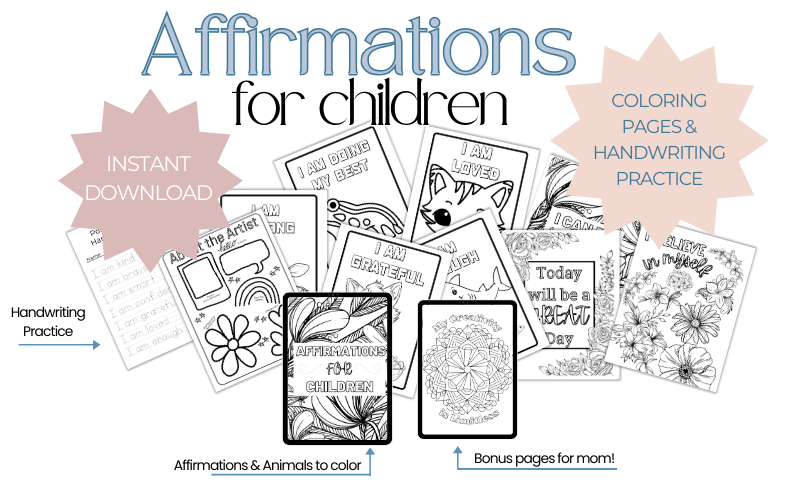
5) Practice Affirmations
Speaking of affirmations, these are such a good practice for kids that even Snoop Dogg is helping out! We listen to the Affirmation Song almost every day on the way to school, and my toddlers love it.
You can also incorporate affirmations into a bedtime routine. My little one has a rainbow above her bed, and on each color are affirmations like “I am Kind”, “I am Confident”, “I am enough”. I used to read them to her, and now she recites them to me – and uses them in daily life!
The first time your kiddo says “I am responsible” and cleans up after themselves with no prompting, you’ll know it’s working for your little ones, too!
6) Celebrate the Little Wins
I’m sure by now you’ve noticed that your kids love praise. Whether they manage to sit still for a whole minute of meditation or remember to say their gratitude before bed, celebrate it!
We’ve been conciously choosing to praise our children in a way that encourages them to find inner approval rather than seek external validation. This is a really powerful way to foster self-confidence and resilience.
Here are some of the phrases we like to use:
Focus on Effort and Process
- “You worked so hard on this!”
- “I can see how much effort you put into that.”
- “You kept trying even when it was tough. That’s really impressive.”
Highlight Internal Strengths
- “You trusted your instincts, and it worked out!”
- “You believed in yourself, and look at what you accomplished.”
- “You stayed calm and figured it out. Great job trusting yourself.”
Encourage Reflection on Personal Feelings
- “How do you feel about what you did?”
- “You seemed really focused while doing that. How does that make you feel?”
- “What part of this are you most proud of?”
Acknowledge Problem-Solving and Creativity
- “You came up with a great solution on your own.”
- “I love how you used your imagination to solve that problem.”
- “You were so creative in how you approached that.”
Emphasize the Joy of Learning and Growth
- “It’s great to see you enjoying the process of learning.”
- “You’re really growing in your ability to handle challenges.”
- “I can see how much you’re learning every time you try.”
These kinds of praise help children internalize a sense of competence and self-worth, making them more likely to seek inner satisfaction and confidence rather than relying on external validation (something I’m still actively trying to recover from. How about you?).
Spiritual practices for kids are all about planting seeds. You won’t see a full-blown oak tree tomorrow, but you’ll see little sprouts—and that’s a win.
7) Create a Special Space
We all love having a space that’s all our own—whether it’s a she-shed, a corner of the couch, or a patch of grass in the backyard. Kids feel the same way, especially when so much of their lives is out of their control.
I’ve made a Calm Corner in my own bedroom with candles, incense, crystals, and journals. My kiddos love sitting on a meditation cushion with me and coloring in their own journals while I write in mine.
Shortly after I made my corner, my 3 year old claimed a spot next to the couch as her “special home” that she now goes and plays in when she needs a moment to herself.
See if you can create a spiritual corner for yourself and one for your kids, where you can each go to practice spirituality or take deep breaths when you need it. Let the little ones pick out a pillow, a cozy blanket, or a favorite stuffed animal to keep there.
Spiritual practices for kids can feel more tangible when they have a dedicated space to do them in. Plus, it gives them a sense of ownership, and suddenly, they’re excited to visit their own little corner of calm.
Teach Kids Spirituality at Their Own Pace
Incorporating spiritual practices for kids into your daily life doesn’t have to be overwhelming. It can be as simple as a shared breath before bedtime or a moment of gratitude at breakfast. Remember to:
- Start with the Basics
- Involve the Whole Family
- Use Play
- Read Together
- Practice Affirmations
- Celebrate the Small Wins
- Create a Sacred Space
The key is to keep it light, keep it fun, and remember that you’re planting seeds. Some days those seeds will sprout, and other days they might just need a little more watering – and it’s all part of the journey.
So, what’s your favorite way to teach your kids about spirituality?
Share your ideas in the comments—I’d love to hear what’s working in your home!
xoxo,
Angie